
Tips / Aligned Pair Exclusion (APE)
Extreme
Aligned Pair Exclusion (APE)
Recommended first: Candidate notation · Pairs and subsets · ALS-XZ
APE selects two blue base cells, pairs their candidates in every possible way, and rejects combinations that lead to contradictions.
If one candidate in base cell A is impossible with every candidate in base cell B, that candidate can be removed from A.
The final elimination is simple. The important part is proving that no pairing has been missed.
1. The ALS fact used by APE
An Almost Locked Set (ALS) consists of N cells in one row, column, or box whose candidate union contains exactly N+1 digits.
Removing one digit from the whole set turns it into an N-cell, N-digit locked set. Removing two different digits would leave only N−1 digits for N cells, which is impossible. APE uses this second fact to reject assignments to the base pair.
2. How an ALS rejects a pairing
Suppose base A takes p and base B takes a different digit q. This pairing is impossible when a yellow ALS satisfies all three conditions:
- both
pandqbelong to the ALS candidate union; - base A sees every occurrence of
pin the ALS; - base B sees every occurrence of
qin the ALS.
A=p removes every p from that ALS, while B=q removes every q. The ALS loses two different digits and cannot fill its N cells. Therefore (p, q) is impossible.
Cells that contain only other ALS digits need not be seen by both bases. The digits do not have to be RCCs. APE is testing a simultaneous assignment against one ALS, not building a link between two ALSs.
3. Type 1: aligned base cells
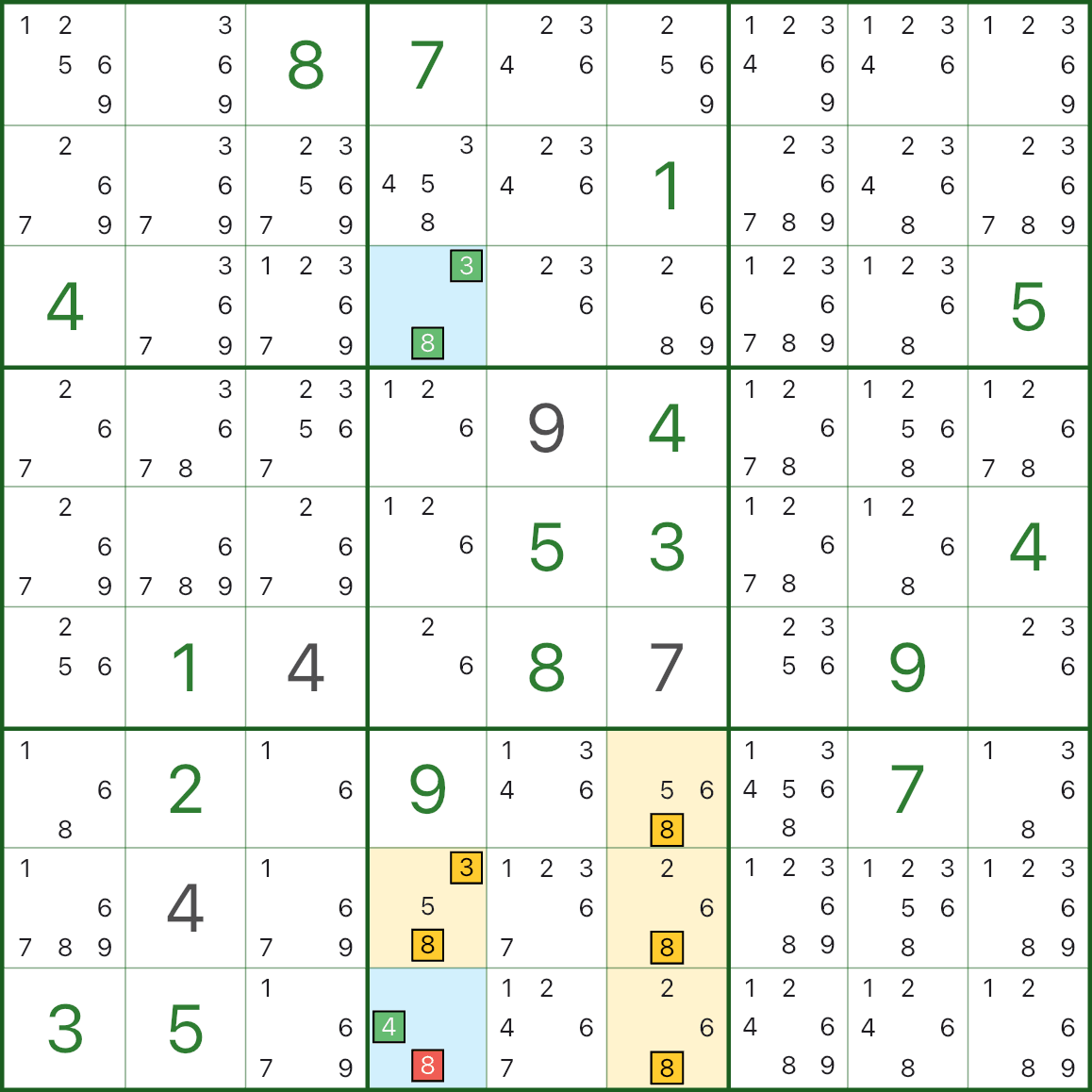
In Type 1, the two base cells see each other because they share a row, column, or box.
(x, x)is rejected directly: the same house cannot contain digit x twice.- A distinct pair
(p, q)is rejected when A sees every ALS occurrence ofpand B sees every occurrence ofq.
The direct same-digit conflict is therefore a legitimate part of the Type 1 proof.
4. Type 2: non-aligned base cells
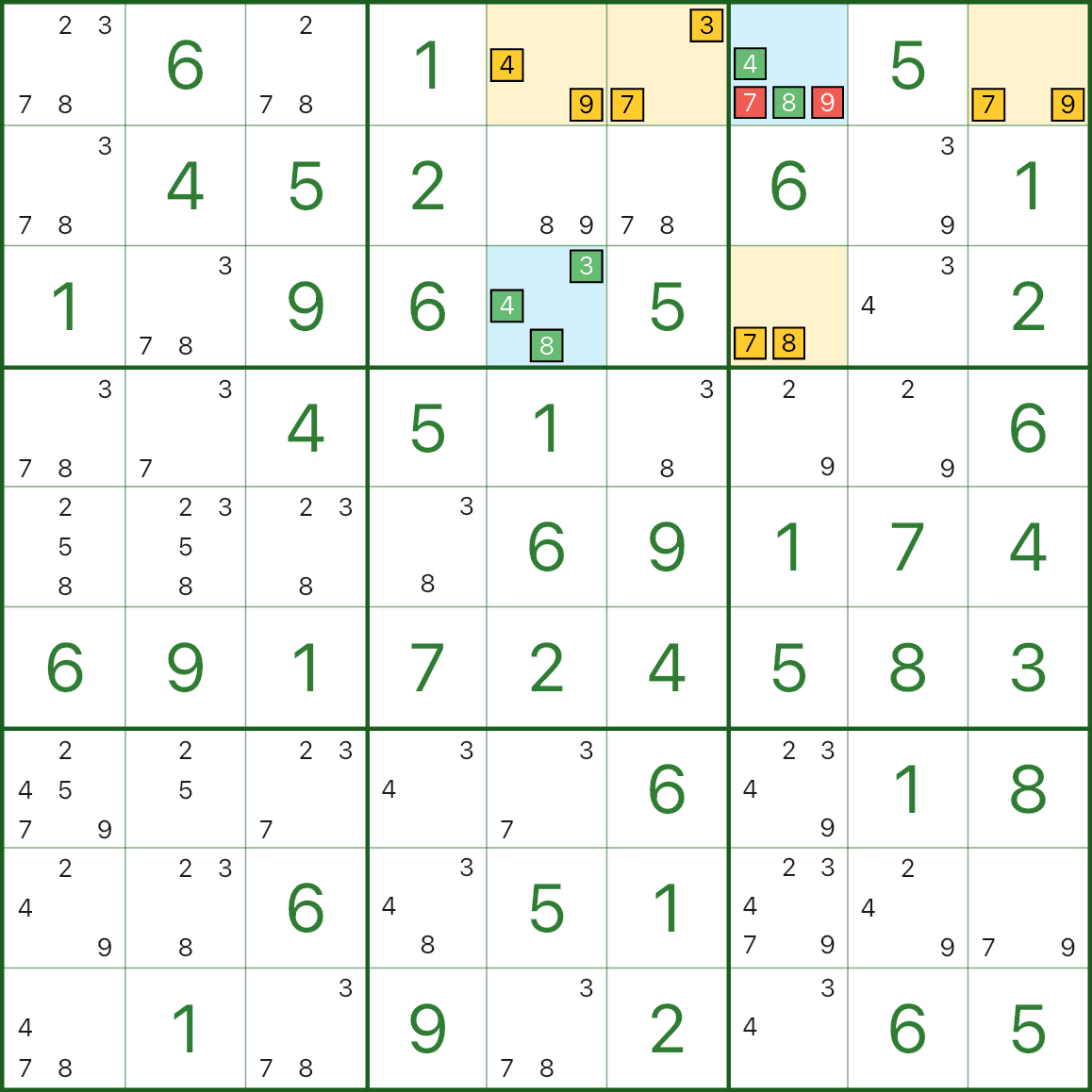
In Type 2, the two base cells do not see each other. They may both contain the same digit, so (x, x) must remain possible.
This is a crucial safety boundary. If both cells contain x, x cannot be removed merely because all their other pairings are blocked: assigning x to both cells may still work. Every rejected Type 2 pairing must use two different digits and have a real ALS contradiction.
5. From rejected pairings to an elimination
Suppose A contains 1, 4 and B contains 1, 6, 8. To test A=4, enumerate every choice in B:
| A | B | Contradiction |
|---|---|---|
| 4 | 1 | ALS P would lose 4 and 1 |
| 4 | 6 | ALS Q would lose 4 and 6 |
| 4 | 8 | ALS R would lose 4 and 8 |
No candidate in B can coexist with A=4, so 4 can be removed from A. One ALS may reject several pairings, or different ALSs may reject them separately. What matters is complete coverage.
The same test is also performed in the other direction: fix a candidate in B and pair it with every candidate in A.
6. Reading the hint colors
- Blue cells are the two base cells.
- Green candidates are the candidates being paired in the base cells.
- Yellow cells form the ALSs actually used in the contradictions.
- Yellow candidates are the two ALS digits removed by a rejected assignment.
- A red candidate has failed against every choice in the other base cell and can be removed.
The hint text lists every failed pairing for each red candidate. Fix the red candidate first, then verify that every candidate from the partner cell appears in the list.
7. Common mistakes
- Rejecting only one pairing is not enough; all partner candidates must fail.
- Each base must see every ALS occurrence of the digit it assumes. Unrelated ALS cells need not be visible.
- An ALS must be N cells in one house with exactly N+1 candidate digits.
- Equal digits conflict only in Type 1. They remain possible in Type 2.
- APE can overlap a pair, wing, or ALS-XZ elimination. The app may retain both explanations while selecting the simpler technique by default.
- APE requires complete candidate notation. Missing candidates can create a false “all pairings fail” conclusion.
8. A reliable checking order
- Confirm that candidates are complete.
- Identify the two base cells and decide whether they are Type 1 or Type 2.
- Fix the candidate proposed for elimination.
- Pair it with every candidate in the other base cell.
- Use a direct equal-digit conflict only for Type 1.
- For each distinct pair, verify a strict N-cell/N+1-digit ALS.
- Verify that each base sees every ALS occurrence of its assigned digit.
- Eliminate only after every pairing has been rejected.
In one sentence: hold one candidate fixed, exhaust every choice in the other cell, and remove it only when every route is impossible.