
Tips / ALS-XZ
Extreme
ALS-XZ
Recommended first: Candidates · Pairs and Subsets
ALS-XZ sounds abstract, but its central idea is simple:
Two candidate sets that are one step away from being locked are joined by a restricted common candidate X. This guarantees that another common candidate Z is true in at least one set.
To understand that statement, we will build it in order: ALS, RCC, X, Z, and the elimination.
1. What is an ALS?
ALS means Almost Locked Set.
A group of cells is an ALS when:
- all cells lie in one row, column, or box and therefore see one another; and
- N cells contain exactly N+1 distinct candidate digits altogether.
For example, two cells with candidates 1,2 and 2,3 contain three distinct digits: 1,2,3. Two cells and three digits make an ALS.
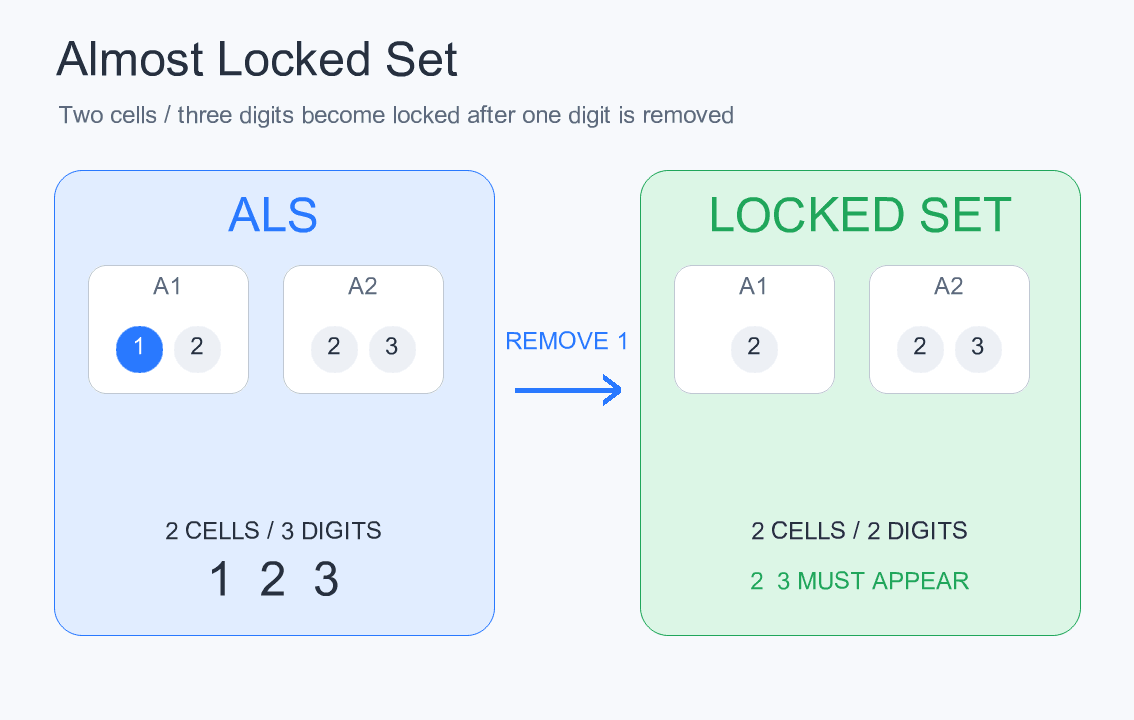
A locked set has N cells and N digits. Those N digits must fill the N cells, so every digit must occur once. An ALS has just one extra digit. If any one digit is excluded from the whole ALS, N digits remain for N cells and the ALS becomes locked.
Remember an ALS as: N mutually visible cells contain N+1 candidates; remove any one digit from the group and it becomes locked.
2. What is an RCC?
Take two non-overlapping ALSs, called ALS A and ALS B.
A digit found in both sets is a common candidate, but a common candidate is not automatically an RCC.
RCC means Restricted Common Candidate. A common candidate X is restricted when:
Every position for X in A sees every position for X in B.
Most often, all those X positions share one row, column, or box. That house can contain X only once, so X cannot be true in both ALSs.
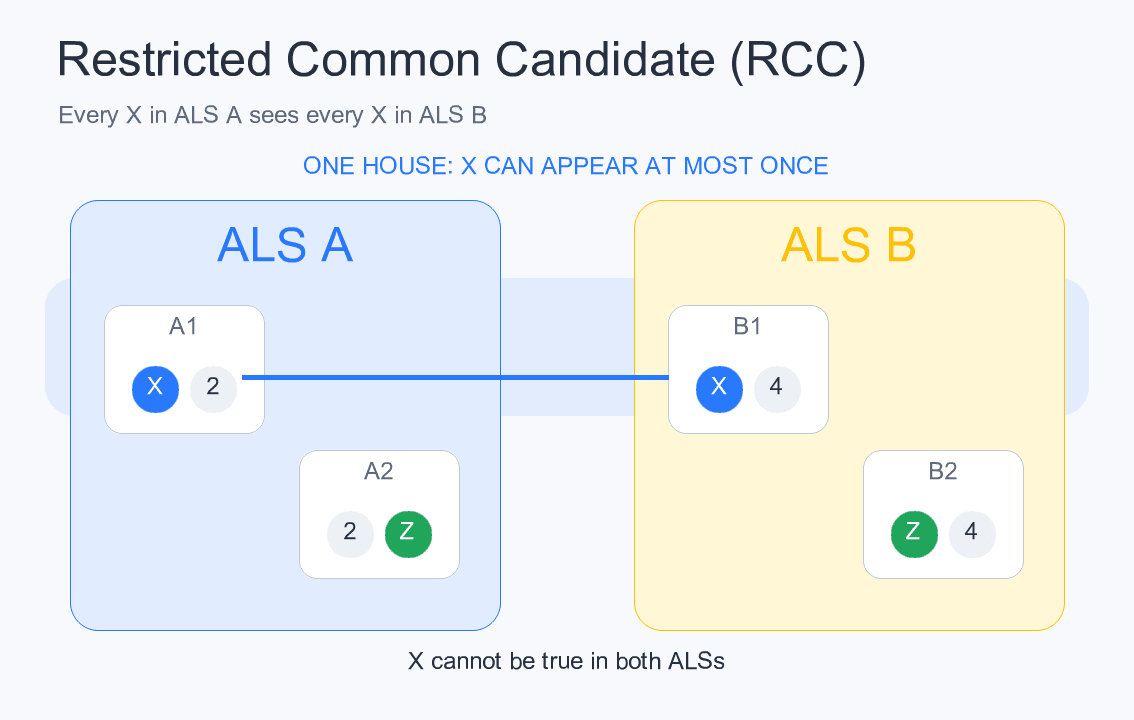
This gives the exact RCC conclusion:
- X can be true in at most one ALS;
- at least one ALS therefore does not use X;
- X may also be absent from both ALSs, so a single RCC does not prove that X itself must appear.
The ALS without X loses one candidate and becomes locked. Every remaining digit in that ALS must appear.
3. How is ALS-XZ formed?
A single-RCC ALS-XZ contains:
- two non-overlapping almost locked sets A and B;
- at least two common candidates, called X and Z;
- X as an RCC, so it cannot be true in both sets;
- Z as another common candidate; and
- an outside Z that sees every possible Z position in both A and B.
In the hint diagram:
- blue cells are ALS A;
- yellow cells are ALS B;
- blue candidates are RCC X;
- green candidates are the guaranteed Z positions;
- red candidates are eliminations.
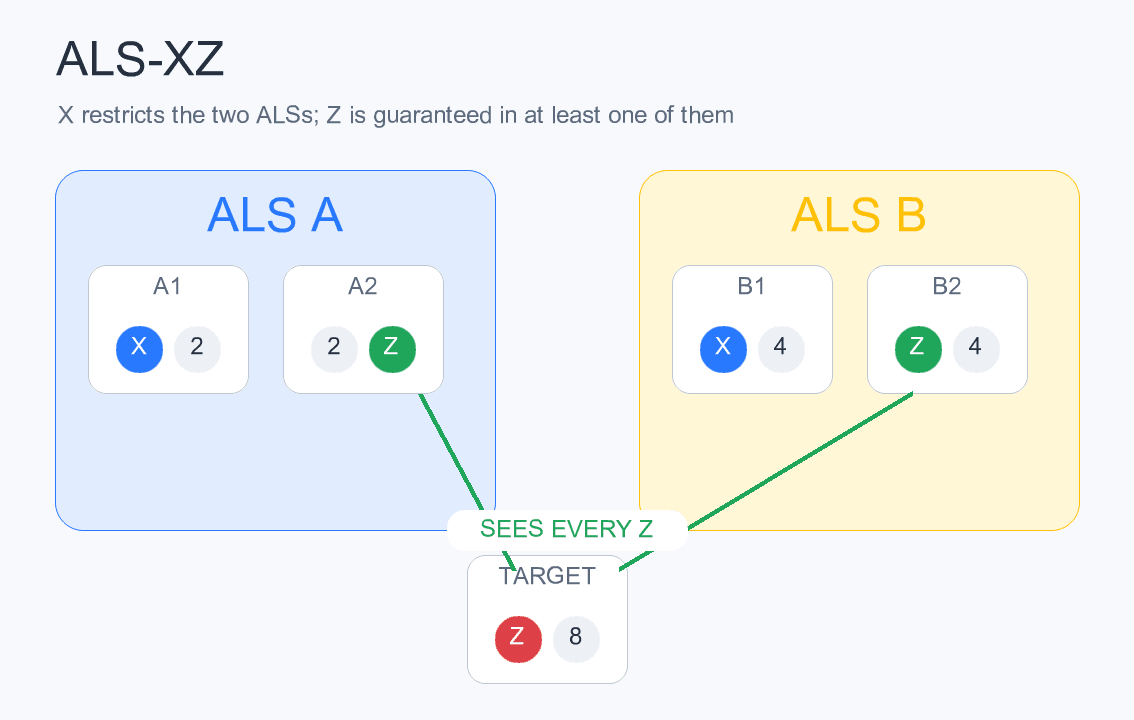
4. Why can Z be eliminated?
Consider every possible location of X.
X is true in A
B cannot use X. B becomes locked, so every remaining digit in B appears, including Z.
X is true in B
A cannot use X. A becomes locked, so Z appears in A.
Neither ALS uses X
Both sets become locked, so Z appears in both. This only strengthens the conclusion.
In every case:
Z appears at least once in ALS A or ALS B.
An outside Z that sees every Z position in both sets conflicts with Z whichever set supplies it, so that outside candidate can be eliminated.
This is why seeing only some Z positions is insufficient: before solving the pattern, we do not know which ALS will become locked.
5. Doubly linked ALS-XZ
Sometimes A and B share two RCCs, X and Y. Each RCC must be absent from at least one set.
The same ALS cannot exclude both X and Y. It would lose two digits from an N+1-digit ALS and have only N−1 digits left for N cells, which cannot fill the set.
Therefore the exclusions must split:
- A excludes one RCC;
- B excludes the other RCC;
- both ALSs lose exactly one digit and become locked.
The diagram shows one possible split: A excludes X and B excludes Y, forcing Y into A and X into B. The opposite split works exactly the same way.
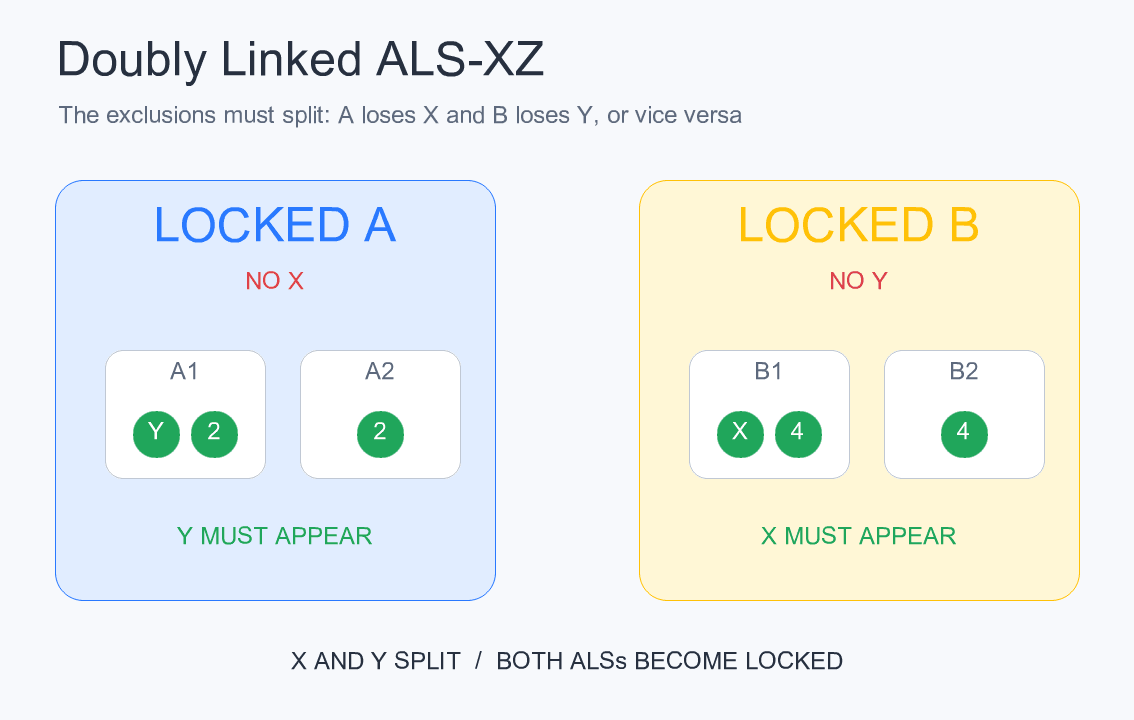
This proves stronger conclusions:
- X and Y each appear exactly once across A and B, one in each set;
- every non-RCC digit in A is locked into A;
- every non-RCC digit in B is locked into B.
Blue RCC marks and green non-RCC marks show these guaranteed positions. A red candidate that sees every marked position of its own digit can be eliminated.
6. Common mistakes
Every common candidate is an RCC
No. Every X in A must see every X in B.
Seeing one Z in each set is enough
No. The elimination must see every possible Z position in both sets.
A single RCC proves X must appear
No. X may be absent from both ALSs. A single-RCC ALS-XZ eliminates the other guaranteed common candidate Z, not X.
The two ALSs may share cells
Not in the ALS-XZ described here. A and B must not overlap.
7. Reading an ALS-XZ hint
- Check the blue ALS A and yellow ALS B: each should have N cells and N+1 digits.
- Check blue X: every X in A must see every X in B.
- Find common candidate Z in both sets.
- Confirm that the green marks include every possible Z position in A and B.
- Confirm that each red candidate sees every green position of the same digit.
When all five checks hold, the elimination follows from the two locked-set possibilities rather than from a guess.