
Tips / Sue de Coq
Extreme
Sue de Coq
Recommended first: Candidate notation · Pairs and subsets · ALS-XZ
Sue de Coq was originally called Two-Sector Disjoint Subsets. It occurs where a row or column intersects a box and combines that intersection with an ALS on each side.
The idea in one sentence is:
Two disjoint side ALSs each leave one of their candidates for the intersection, causing the intersection and each side to form overlapping locked sets.
The conclusion is compact, but the counting proof matters. This article develops it from the beginning.
1. Locked sets, ALSs, and the intersection
A locked set contains N cells in one house with exactly N candidate digits. Those digits must fill those cells. A naked pair is the smallest familiar example.
An ALS (Almost Locked Set) contains N cells in one house with exactly N+1 candidate digits. It is one digit short of being locked: remove any one digit from the whole set and the remaining N digits must fill its N cells. A bivalue cell is a one-cell ALS.
Where a row or column crosses a box, at most three cells belong to both houses. Sue de Coq calls the selected unsolved cells the intersection C, and calls their candidate union V.
The common basic forms are:
- two intersection cells with four candidates;
- three intersection cells with five candidates.
Both have two more candidate digits than cells. A larger gap is possible when the side groups contain more cells.
2. The strict structure
The hint colors are:
- blue cells: intersection C;
- yellow cells: line-side ALS L, outside the intersection;
- green cells: box-side ALS B, outside the intersection;
- red candidates: eliminations.
A strict Sue de Coq satisfies all of these conditions:
- C has at least two cells and candidate union V;
- L is a strict ALS: p cells and exactly p+1 candidates;
- B is a strict ALS: q cells and exactly q+1 candidates;
- every candidate in L and B is drawn from V;
- the candidate sets of L and B are disjoint;
- the number of colored cells equals the number of digits in V:
|C| + |L| + |B| = |V|
The fifth condition supplies “disjoint” in the original name. If a digit from V is assigned to both side sets, the proof below no longer works.
3. Why each ALS must give one digit to the intersection
Suppose the yellow ALS has p cells and p+1 candidate digits. Its cells share a line, so they must contain p different digits. Exactly one digit from its candidate set is therefore absent from the yellow cells.
The green ALS behaves the same way: exactly one of its q+1 digits is absent from its q cells.
Every blue intersection cell sees every yellow cell through the row or column, and sees every green cell through the box. A digit already used by either side cannot also enter C. The only digits available to C are therefore:
- the one digit omitted by the yellow ALS;
- the one digit omitted by the green ALS;
- any digits of V assigned to neither side.
The cell-count equation guarantees that this list contains exactly |C| digits. Hence C must contain all of them.
C takes one omitted digit from each ALS and every intersection-only digit.
We never need to know which particular digit each ALS omits.
4. Two overlapping locked sets
Take any candidate belonging to the yellow ALS. If the yellow ALS uses it, it lies in the line. If the yellow ALS omits it, the digit must appear in the blue intersection, which is still in that line. Thus every yellow-side digit is locked into the yellow cells plus C and can be removed elsewhere in the row or column.
Likewise, every green-side digit is locked into the green cells plus C and can be removed elsewhere in the box.
Any intersection-only digit can occur only in C. Because C belongs to both houses, that digit is locked in both the line and the box.
This is the heart of Sue de Coq:
C+L is a line locked set, while C+B is a box locked set, and the two share C.
5. The classic two-cell, four-digit form
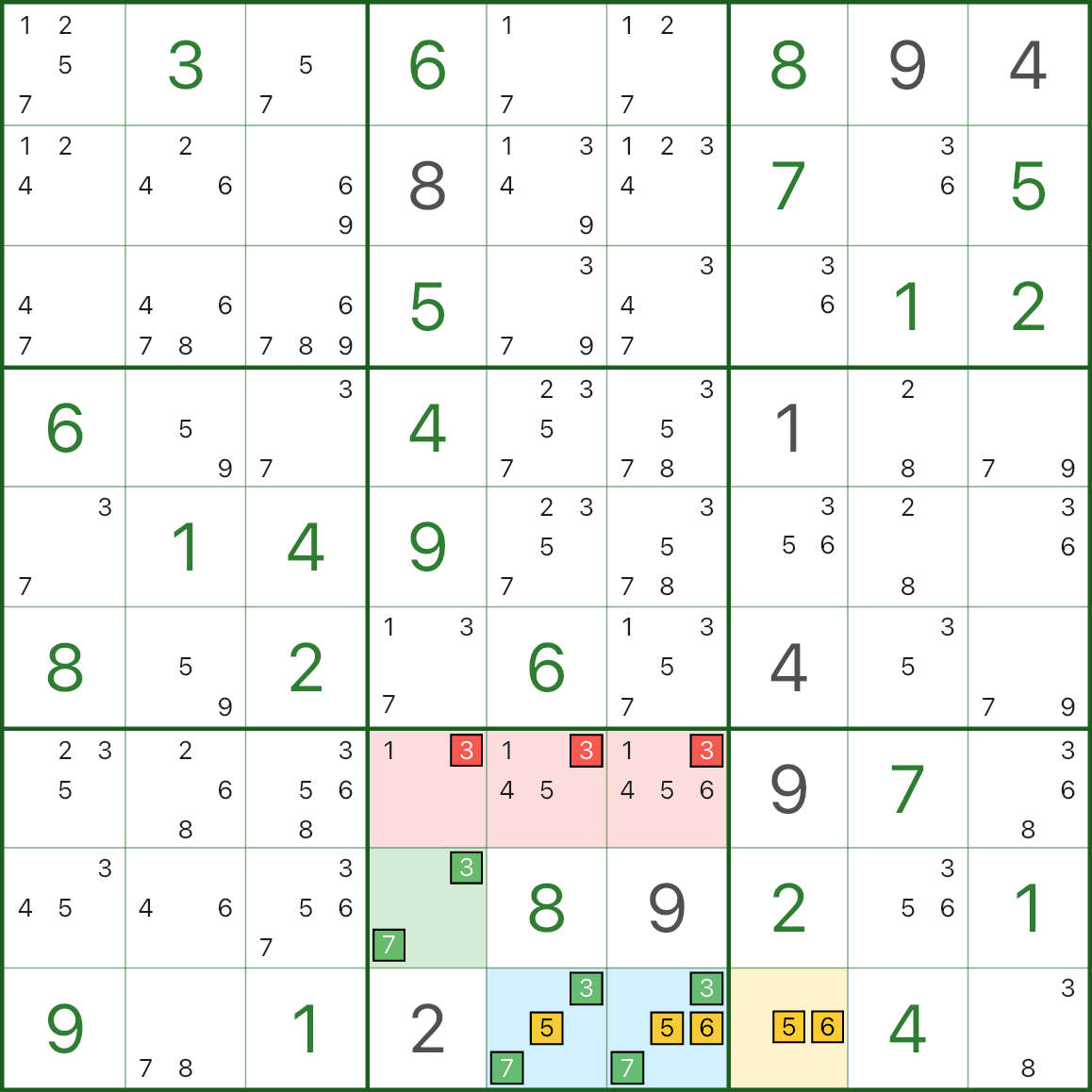
Assume two blue cells contain the union 1,2,3,4.
- a yellow line-side bivalue cell contains
1,2; - a green box-side bivalue cell contains
3,4.
The yellow cell uses one of 1,2, so the other must enter C. The green cell uses one of 3,4, so the other must also enter C. Those two omitted digits fill the two blue cells.
Consequently, 1,2 are locked in the line and 3,4 are locked in the box. No guess about the exact contents of C is needed.
6. Three cells and an intersection-only digit
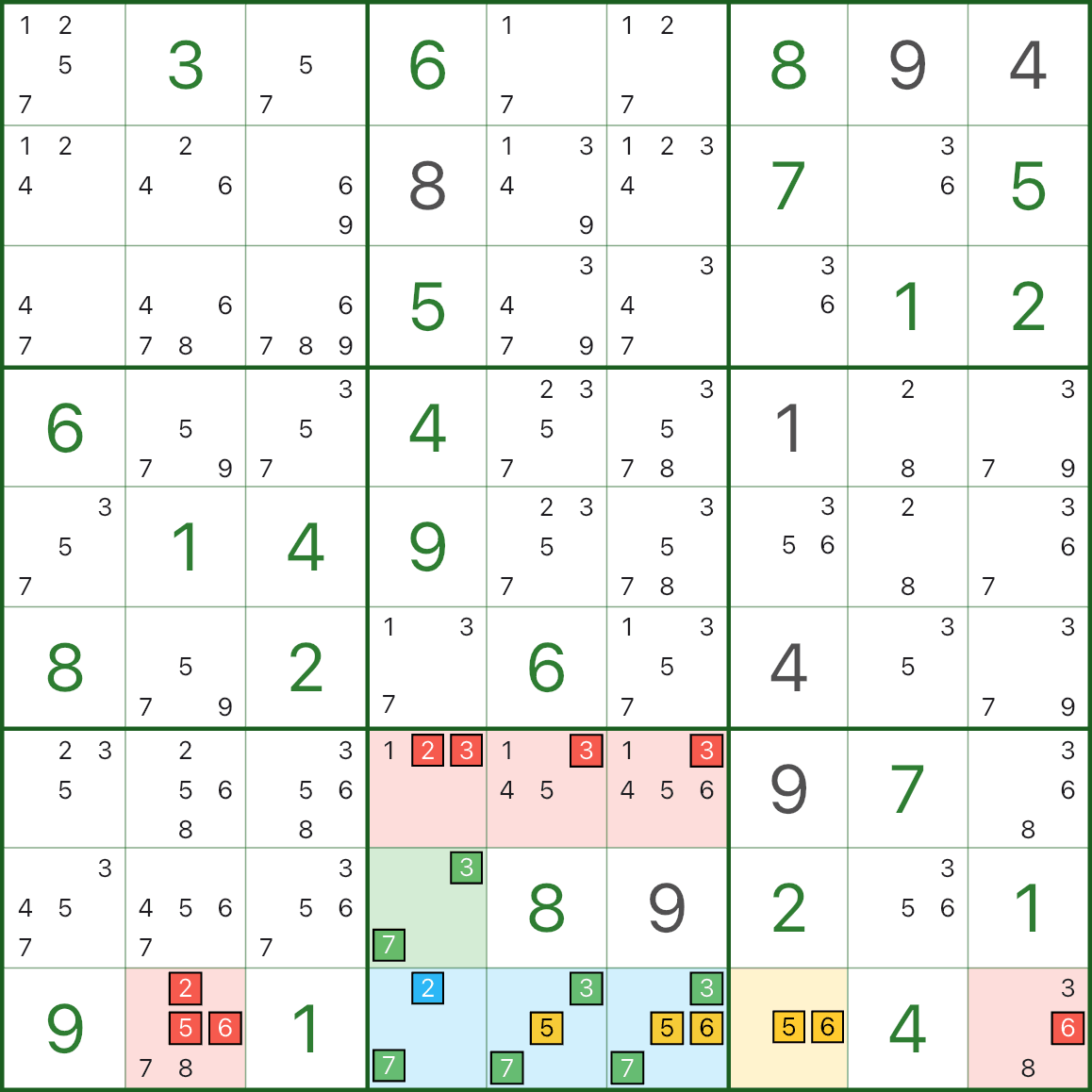
Now let three blue cells contain 1,2,3,4,5.
- the yellow side uses
1,2; - the green side uses
3,4; - digit
5belongs to neither side.
One omitted digit from each ALS plus the intersection-only 5 fills the three blue cells. Therefore 1,2,5 are locked in the line, 3,4,5 are locked in the box, and 5 may produce eliminations in both houses.
7. A side can be a larger ALS
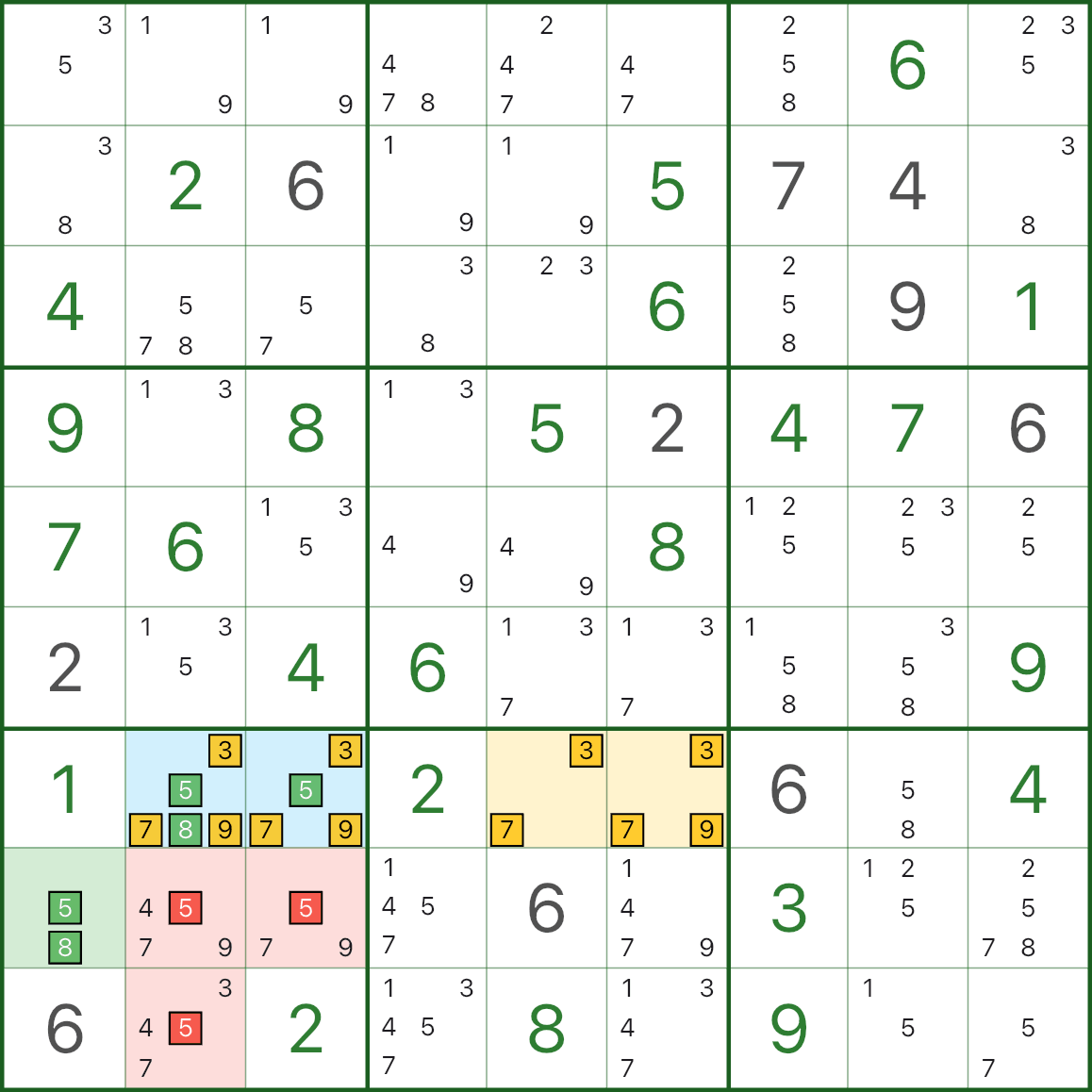
A bivalue cell is only the smallest ALS. A side may contain several cells.
For example, green cells 3,4 and 4,5 have candidate union 3,4,5. They form a two-cell, three-digit ALS. They use two digits, and the omitted third digit must enter C exactly as in the bivalue example.
For a multi-cell side, check the group as a whole:
- every cell is in the same side house;
- N cells have exactly N+1 candidate digits;
- every digit belongs to V;
- no digit is assigned to the other side.
8. How it differs from ALS-XZ and APE
ALS-XZ links two ALSs with an RCC and guarantees another common digit. Sue de Coq does not use an RCC chain. It partitions the intersection candidates between two disjoint side sets and closes the proof with exact counting.
APE fixes a candidate in one base cell, pairs it with every candidate in another cell, and rejects every pairing through ALS contradictions. Sue de Coq does not enumerate assignments: once its global count is exact, both locked-set conclusions follow at once.
The same elimination can occasionally have a simpler subset, ALS, or APE explanation. Normal hints still choose the lowest-difficulty valid explanation; Sue de Coq training deliberately retains the complete Sue de Coq structure.
9. Current scope and Extended Sue de Coq
The app implements the strict in-V form, where every side candidate is drawn from the intersection set:
- all side candidates must come from V;
- the two side candidate sets must be disjoint;
- each side must be a strict N-cell/N+1-digit ALS;
- all unsolved cells in the chosen intersection are used.
Two/four or three/five intersections with one bivalue cell on each side are the classic Basic Variants. The app also supports the in-V generalization with multi-cell side ALSs; some guides classify that generalization under Extended Sue de Coq.
The broader Extended Sue de Coq can allow side candidates outside V and can sometimes use only part of a three-cell intersection. Each external candidate requires additional cells and the more general counting formula. The app intentionally does not label those broader patterns as this technique.
10. Common false positives
- The two sides share a candidate. The strict disjoint proof fails.
- A side is not N cells/N+1 digits. It does not omit exactly one digit.
- A side contains a digit outside V. That requires Extended Sue de Coq logic.
- The total cell count does not equal |V|. The intersection retains extra freedom.
- Candidates are removed from the wrong sector. Yellow-side digits lock in the line; green-side digits lock in the box; only intersection-only digits lock in both.
- Candidate notation is incomplete. Missing one candidate can manufacture a false ALS or a false count equality.
11. Reliable checking order
- Find the two or three blue intersection cells and list V.
- Verify the yellow line-side ALS: N cells, N+1 digits, all drawn from V.
- Verify the green box-side ALS in the same way.
- Confirm that the two side candidate sets are disjoint.
- Confirm that the total colored cell count equals |V|.
- Remove yellow-side digits elsewhere in the line.
- Remove green-side digits elsewhere in the box.
- If V contains intersection-only digits, check both houses for extra eliminations.
In one sentence:
Two disjoint ALSs each yield one digit to the intersection, turning the intersection plus each side into a locked set.