
Tips / Hidden Rectangle
Advanced
Hidden Rectangle
Recommended first: Uniqueness · Unique Rectangles
A Hidden Rectangle prevents the same dangerous result as a regular Unique Rectangle:
7  9       9  7
       ↔
9  7       7  9
If four corners in two rows, two columns, and exactly two boxes were left with only the same pair, swapping the two digits would produce a second solution. Extra candidates hide that pair in some corners. Bivalue corners and strong links reveal what would force the deadly rectangle to appear.
The explanations below use the coordinates shown in each illustration so every step can be followed directly on the grid.
1. Reading the illustrations
- Blue cells are the four rectangle corners.
- Green candidates are the two digits shared by every corner.
- Yellow candidates and houses show the bivalue corners and required strong links.
- Red candidates are the eliminations.
A strong link means that a digit has only two positions in the entire row or column. At least one endpoint must therefore be true; if one is removed, the other is forced.
2. Type 1: one bivalue corner, two strong links
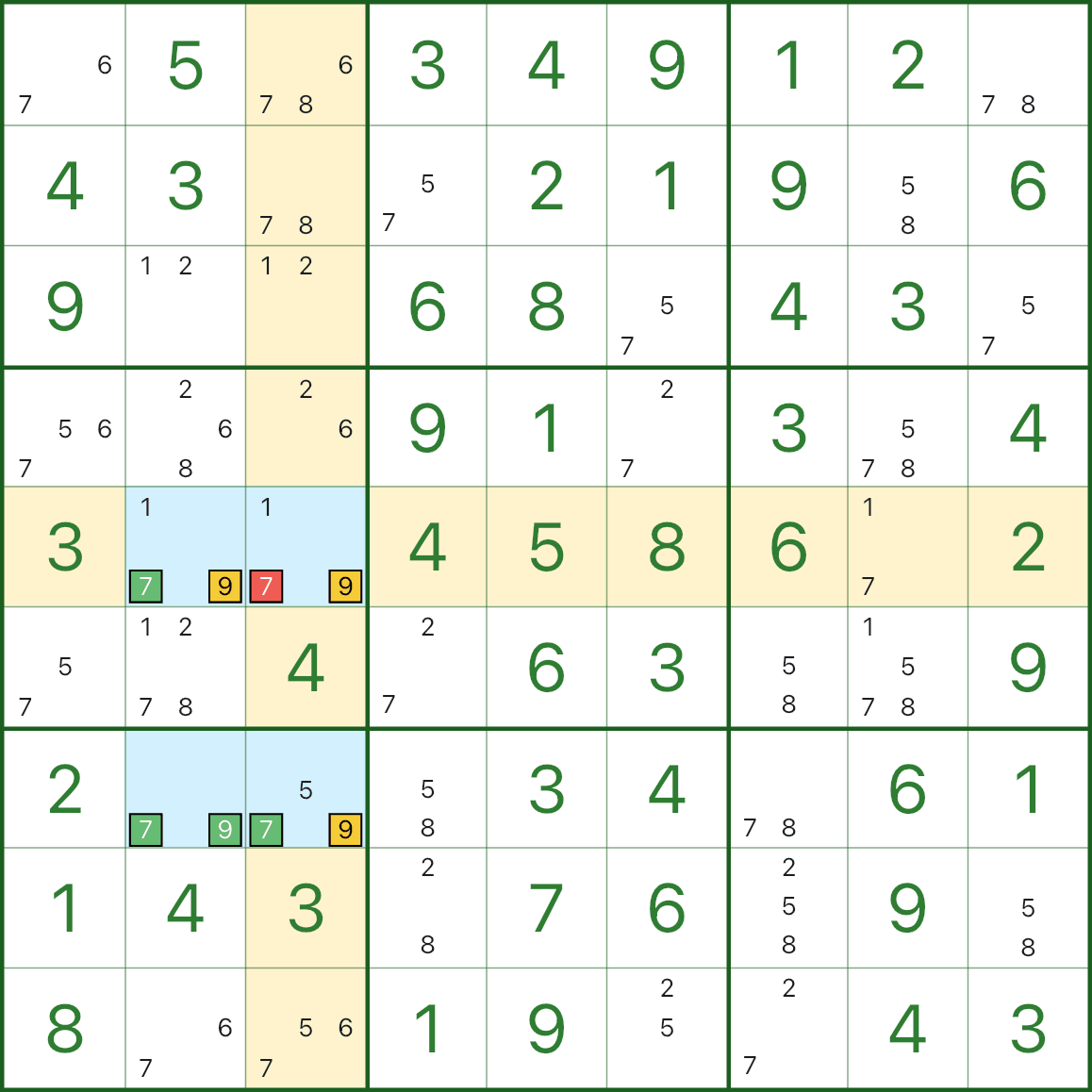
The four blue corners are r5c2, r5c3, r7c2, and r7c3.
- Every corner contains
7/9. r7c2contains only7/9.- In row 5, candidate 9 occurs only at
r5c2andr5c3. - In column 3, candidate 9 occurs only at
r5c3andr7c3.
The last two facts are the two strong links through r5c3. The red candidate is r5c3#7.
Suppose r5c3=7:
- The row strong link forces
r5c2=9. - The column strong link forces
r7c3=9. - The bivalue corner
r7c2must then be 7. - The four corners are reduced to a swappable
7/9rectangle.
That would create a second solution, so eliminate r5c3#7.
Spotting order: find the lone bivalue corner, inspect its diagonal corner, then check whether the other core digit has a strong link in both that corner's row and column.
3. Type 2: two same-box bivalue corners
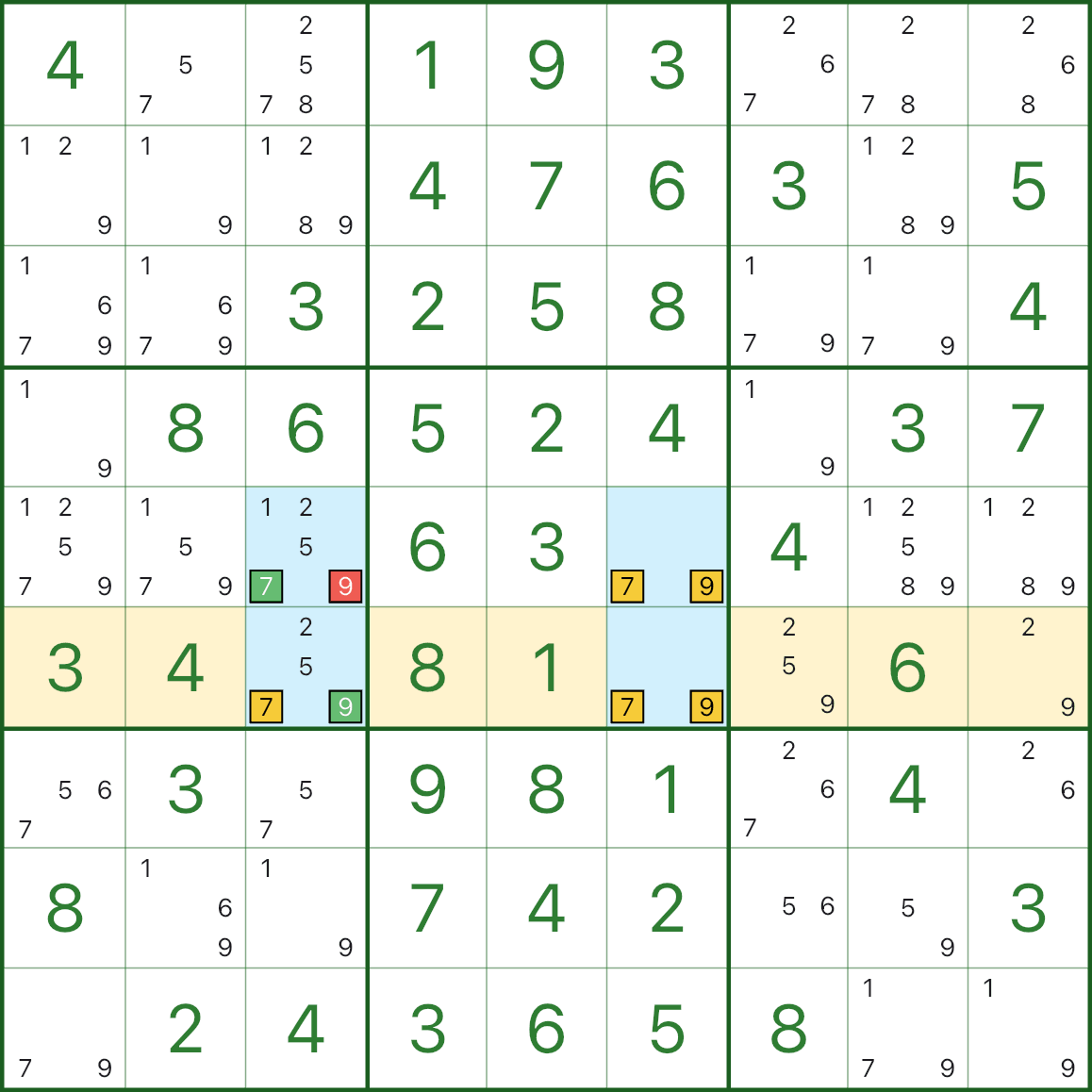
First identify the four roles without assigning abstract labels:
- The blue corners
r5c3,r5c6,r6c3, andr6c6all contain7/9. r5c6andr6c6contain only7/9; these are the two bivalue corners.- In row 6, candidate 7 occurs only at
r6c3andr6c6, so they form a strong link. - The red candidate is
r5c3#9.
Suppose r5c3=9, then follow the rectangle:
- The same-row bivalue corner
r5c6cannot be 9, so it is 7. - The other bivalue corner
r6c6cannot be 7, so it is 9. - Since
r6c6is not 7, the row-6 strong link forcesr6c3=7. - The two rows become
9,7and7,9: a swappable deadly rectangle.
Therefore eliminate r5c3#9.
The useful sequence is: red candidate → adjacent bivalue corner → other bivalue corner → other end of the strong link → deadly rectangle.
4. Type 2b: the bivalue corners cross two boxes
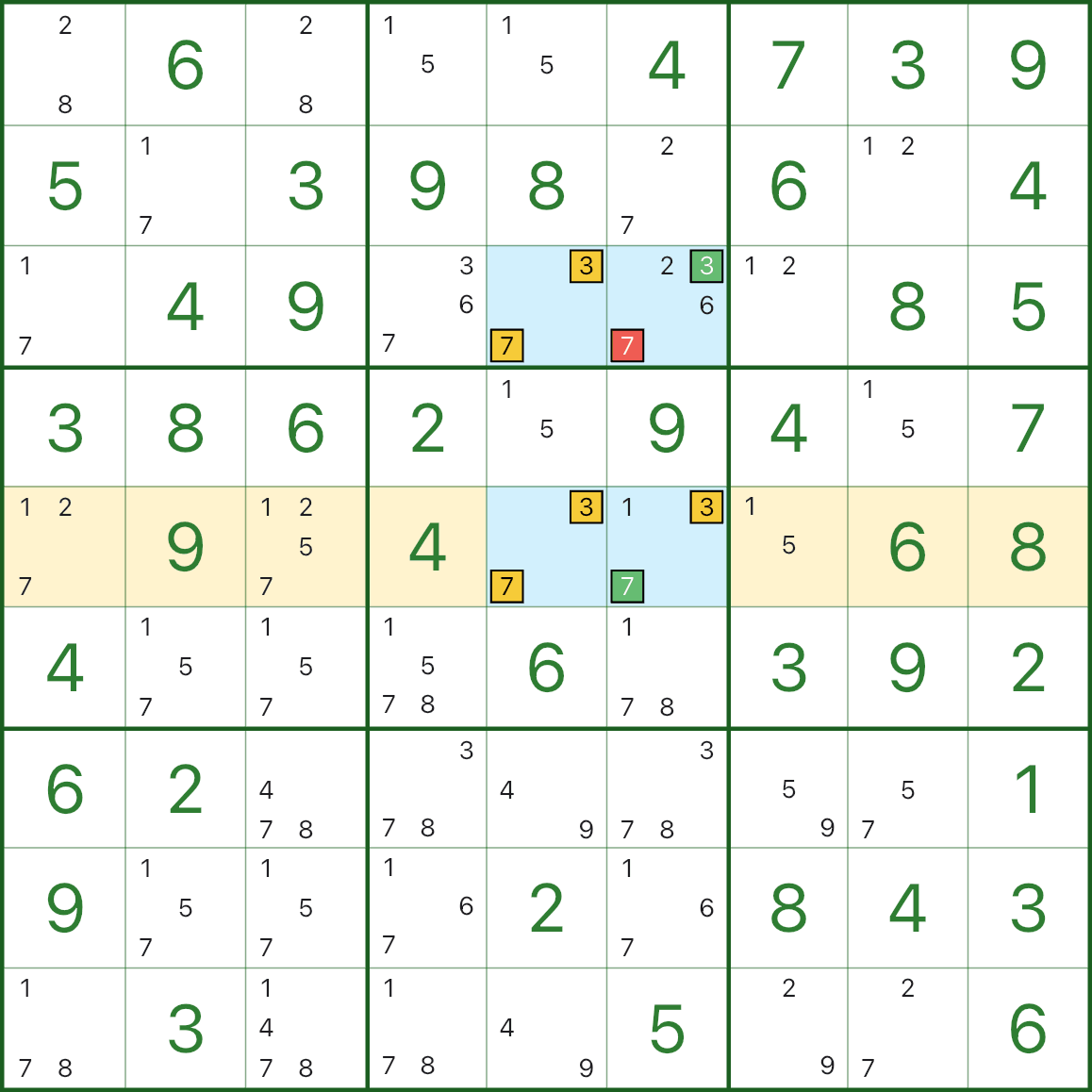
Type 2b uses exactly the same proof. Only the positions of the two bivalue corners differ.
In the illustration:
r3c5,r3c6,r5c5, andr5c6all contain3/7.r3c5andr5c5contain only3/7; they share a column but lie in different boxes.- Candidate 3 in row 3 occurs only at
r3c5andr3c6. - The red candidate is
r5c6#7.
If r5c6=7, then r5c5=3, r3c5=7, and the strong link forces r3c6=3. The four corners become a swappable 3/7 rectangle, so eliminate r5c6#7.
Type 2 places the two bivalue corners in the same box. Type 2b places them in different boxes, but they must still share a row or column. The full rectangle must always occupy exactly two boxes.
5. Verification checklist
- Do the four unsolved cells use two rows, two columns, and exactly two boxes?
- Does every corner contain the same core pair?
- Does Type 1 have one bivalue corner and both required strong links?
- Does Type 2/2b have two adjacent bivalue corners rather than diagonal ones?
- Does each strong-link row or column truly contain only two positions for that digit?
- Are the candidate notes complete?
A Type 2 or Type 2b rectangle can support two separate eliminations when two different strong links exist. Each elimination still needs its own complete path through the two bivalue corners and one strong link.