
Tips / ALS-XY-Wing
Extreme
ALS-XY-Wing
Related techniques: ALS-XZ · XY-Wing · Alternating Inference Chains
An ALS-XY-Wing joins three ALSs with two RCCs. It behaves like a short chain, but each node is an almost locked set rather than a single candidate.
Keep the conclusion in mind: the outer ALSs' common candidate Z must occur in at least one outer ALS, so an external Z that sees every Z position in both outer ALSs can be eliminated.
1. What is an ALS?
An Almost Locked Set contains:
- N mutually visible cells in one house;
- exactly N+1 different candidates across those cells.
For example, two cells whose combined candidates are 1,3,4 form a two-cell ALS.
An ALS has only one candidate more than a locked set. If any one digit is removed from the whole ALS, N digits remain for N cells. The group becomes locked, and every remaining digit must occur inside it.
Remember it as: N cells contain N+1 candidates; remove any one digit and N cells are left with N digits.
2. What is an RCC?
Suppose two disjoint ALSs share candidate X. X is a Restricted Common Candidate when every X position in one ALS sees every X position in the other.
X cannot be true in both ALSs. If the first ALS uses X, the second loses X and becomes locked. An RCC does not promise that X occurs somewhere; it carries a locking consequence from one ALS to the next.
3. How an ALS-XY-Wing is formed
Use three pairwise disjoint ALSs called A, B, and C:
- A and B are linked by RCC X;
- B and C are linked by a different RCC Y;
- the outer ALSs A and C share candidate Z;
- an external Z sees every possible Z position in both A and C.
B is the middle or pivot ALS. A and C are the outer wings. A wing may contain several cells; it is not required to be a single bivalue cell.
The game uses a strict first version: A-B and B-C each have exactly one RCC, and A-C has no third RCC. If A, B, and C are all single bivalue cells, the clearer ordinary XY-Wing classification is used.
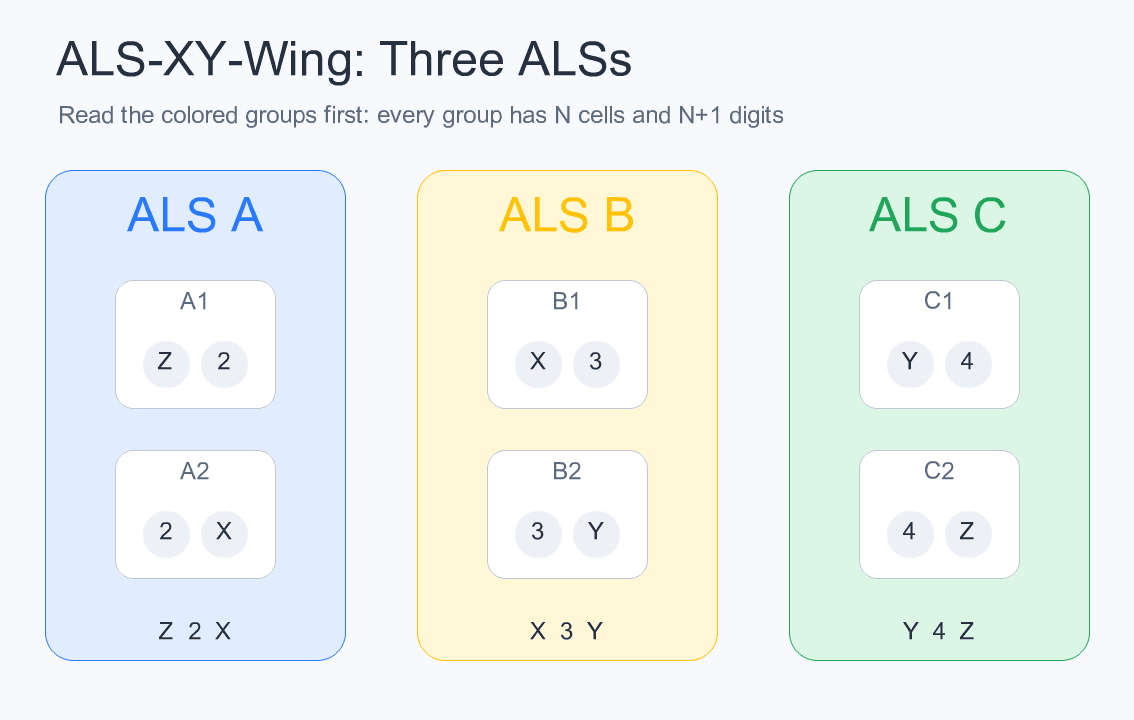
On the first pass, inspect only the colored groups and verify N cells / N+1 digits. Then look for the two links: the outer groups share Z, while the middle group connects to them through X and Y.
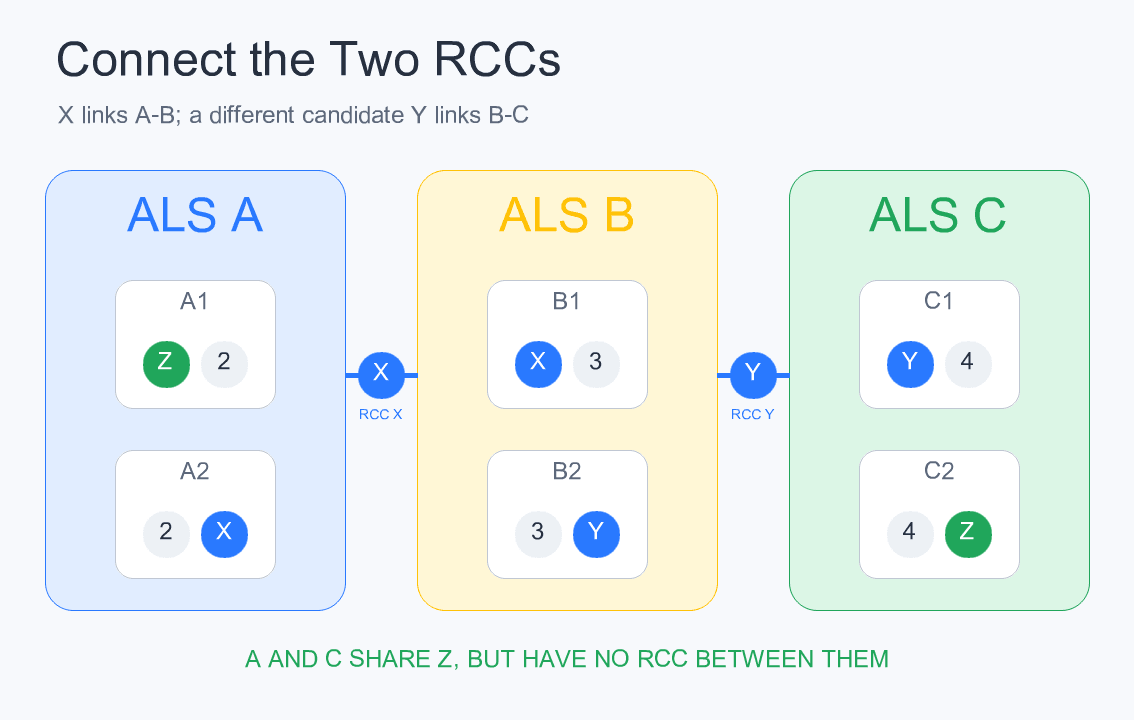
4. Why Z must occur in A or C
Only one question is needed: does A contain Z?
Case 1: Z occurs in A
The conclusion is already true: one outer ALS contains Z.
Case 2: Z does not occur in A
The locking consequence travels along A→B→C:
- without Z, A becomes locked, so X must occur in A;
- X is the A-B RCC, so X cannot occur in B;
- without X, B becomes locked, so Y must occur in B;
- Y is the B-C RCC, so Y cannot occur in C;
- without Y, C becomes locked, so Z must occur in C.
Therefore, in every case:
Z occurs at least once in ALS A or ALS C.
The pattern does not guess which outer ALS supplies Z. It proves that both outer ALSs cannot omit Z.
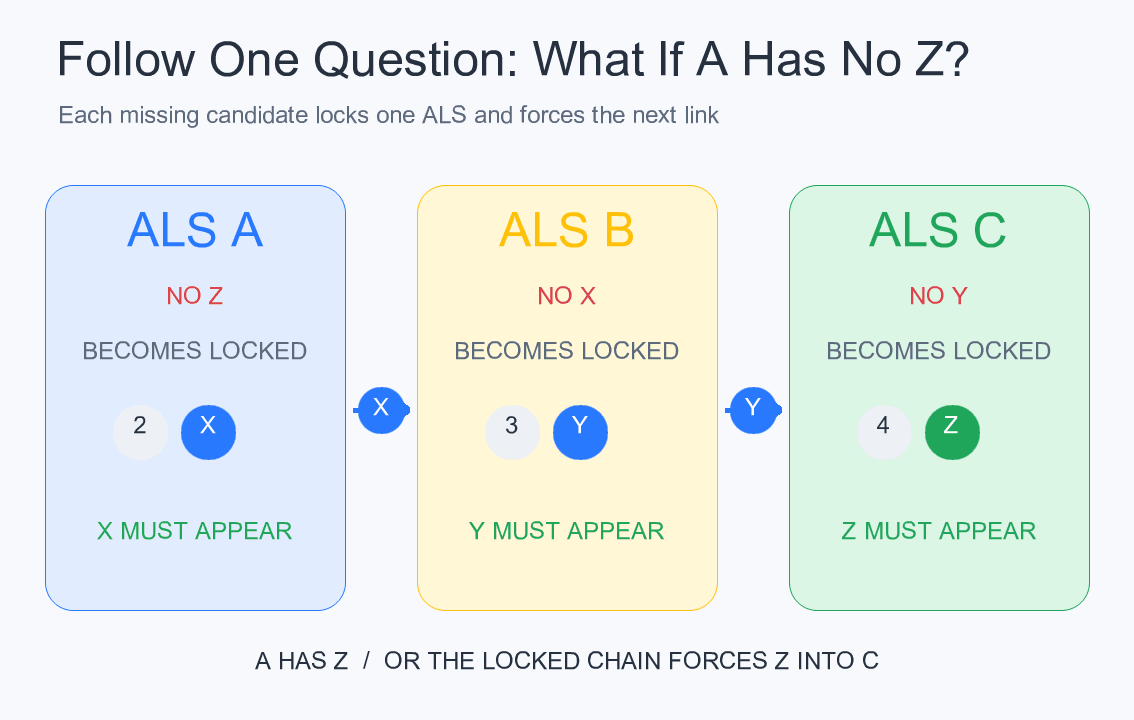
5. How the elimination works
Because we do not know whether Z is supplied by A or C, a target must:
- see every Z position in A;
- see every Z position in C;
- lie outside A, B, and C.
Such a target conflicts with Z whichever outer ALS supplies it, so Z can be removed there. Seeing only one Z position in an ALS is insufficient when that ALS has several possible Z positions.
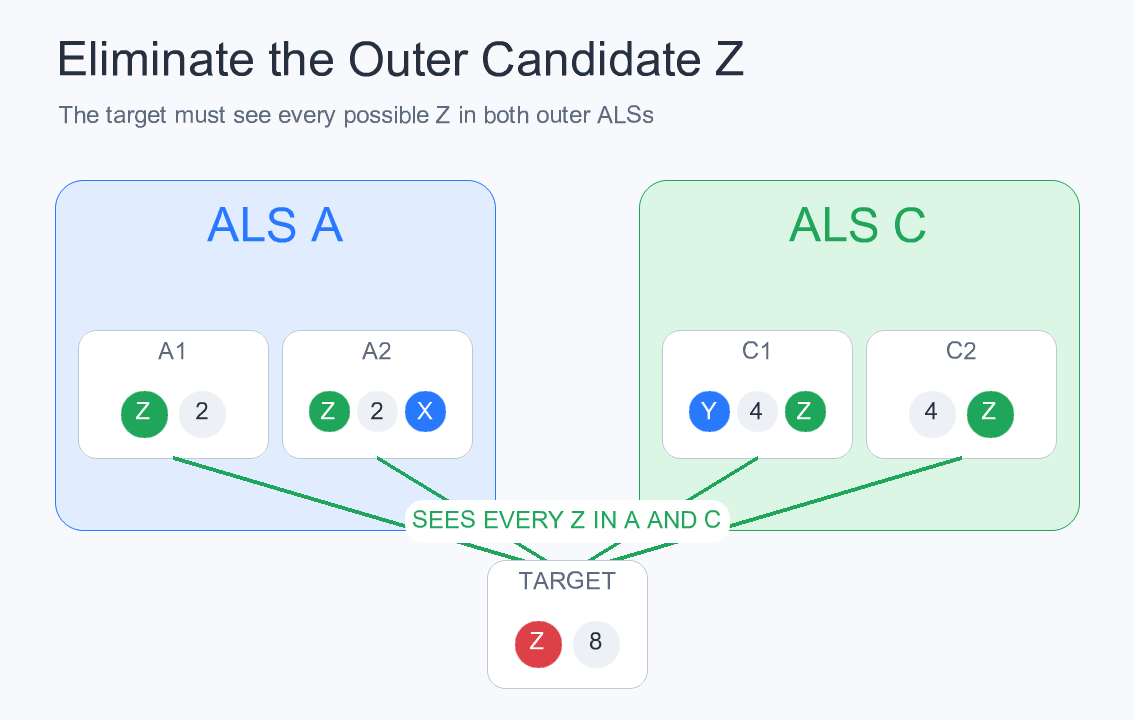
6. Related techniques
Ordinary XY-Wing
An ordinary XY-Wing uses three bivalue cells. ALS-XY-Wing expands at least one of those cells into an ALS group. When all three groups contain one cell, the game keeps the ordinary XY-Wing name and diagram.
ALS-XZ
ALS-XZ uses two ALSs and one RCC to guarantee another common candidate. ALS-XY-Wing uses three ALSs, and the guarantee reaches the other outer group through two locking steps.
ALS chains and loops
If A and C are also connected by an RCC, the structure closes into an ALS loop. Adding more ALS nodes produces a general ALS chain. This technique deliberately covers only the open three-node, two-link form.
7. Reading the in-game hint
- Blue, yellow, and green cells are ALS A, B, and C. Verify N cells and N+1 candidates in each group.
- Blue candidate marks show the two RCCs: X links A-B and Y links B-C.
- Green marks show every Z position in the outer ALSs A and C.
- Follow A→B→C: if A has no Z, the chain forces X, then Y, and finally Z in C.
- Red candidates see every green Z position in both outer ALSs and can be removed.
Read the hint in four passes: group colors, blue RCCs, green outer Z positions, and only then the red elimination. On a first reading, ignore the other candidates and follow only the sequence Z → X → Y → Z.